

Vienna Conference 2026
SUSANNE K. LANGER:
Artistic Angles, Philosophical Circles, Poetic Dots, and Technical Lines
The architectonic vernacular of angles, circles, dots, and lines composes the conceptual sketchpad that maps the theoretical edifice of Susanne K. Langer’s work in logic, the arts, a philosophy of mind, and philosophy of science. This conference explores Langer’s philosophical framework and invites scholars as well as artists to actuate her philosophical methods, spanning from logical analysis and synthesis to embodied cognition, symbolic projection and understanding.
KEYNOTE SPEAKERS
Salomé Voegelin (CH), Sander Verhaegh (NL), and Adam Nocek (USA).
Artistic Angles
Perceived as an artists’ philosopher, Susanne K. Langer’s thought has informed media-theoretical debates on the affective turn, conceptual undercurrents of carnal rhetorics and speculations in new materialism(s), providing a toolkit to capture the artefacts of expressiveness. This distinctive artistic angle for theory shapes Langer’s approach to the body-mind and to aesthetic cognition. Her philosophy, synthesizing Alfred N. Whitehead’s process metaphysics and Ernst Cassirer’s anthropology of symbolic forms, echoes later post-structuralist movements in its exploration of non-linguistic dimensions of meaning. These intersections situate Langer’s philosophy of artistic expressiveness as a mode of epistemological import.
Philosophical Circles
Langer’s orbital relationship with the Vienna Circle is exemplified in her 1930 book, The Practice of Philosophy (praised by Moritz Schlick), in which she was among the first to articulate the “’analytic` type” of philosophy (p. 17), well before its widespread adoption in the 1950s. She also played a key role in helping exiled Vienna Circle members (e.g. Herbert Feigl or Eugen T. Gadol) settle in the United States in the 1930s and 1940s. Establishing her own philosophical circle at Harvard, devoted to the discussion of logic, Langer bridged the transatlantic evolution of analytic philosophy. Her scholarly thinking blended empirical rigour and experiential meaning-making with process-oriented thought.
Poetic Dots and Technical Lines
Langer’s legacy – one that bridges philosophical and epistemic divides – invites a re-negotiation of living form; for Langer, mind is grounded in an intricate matrix of exogenic and autogenic processes that expand the idea of living and non-living entities, and the systems they are embedded in. The continued computational turn – advancements in algorithmic learning and synthetic biology – blur the contours of mechanics and organism, life and form.
This conference seeks to make tangible the poetic and technological transversality currently intersecting philosophy, science, and the arts.
Organized in collaboration with the Research Unit Architecture Theory and Philosophy of Technics ATTP at the Vienna University of Technology and the IVC Institute Vienna Circle at the University of Vienna, this conference illuminates the history and relevance of Susanne K. Langer’s philosophy—demonstrating how her thought continues in contemporary debates in philosophy, aesthetics, the arts, and science, and how it is linked to the city of ideas, Vienna.
Committee: Prof. Vera Bühlmann (AT), Dr. Lona Gaikis (AT), Tereza Hadravová (CZ), Dr. Matthew Ingram (USA), Prof. Randall E. Auxier (USA), Prof. Christian Grüny (DE).
Format: In person only.
KEYNOTE LECTURE PROGRAM
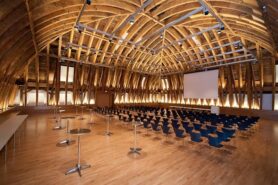
Spread across four days (26–29 May 2026), presentations of academic research on Langer’s philosophy and legacy will be held in plenary sessions at the Kuppelsaal of TU Wien.
Evening events will include public keynote lectures and panel discussions with experts, contextualizing Langer’s work and highlighting its contemporary relevance. These lectures and conversations will take place on Tuesday, Wednesday, and Thursday.
Tuesday, 26. May 2026.
PUBLIC LECTURE ON ARTISTIC ANGLES
Salomé Voegelin (UK) (confirmed)
Salomé Voegelin is Professor of Sound at the London College of Communication, University of the Arts, London, UK. Salomé is a writer, researcher, and practitioner, who works from the relational logic of sound to focus on the in-between and the liminal, where different disciplines meet to deal with contemporary issues, and where feminist, decolonial, and post-anthropocentric demands can engender different and plural knowledge possibilities. She is the author of Listening to Noise and Silence (2010), Sonic Possible Worlds (2014/21), The Political Possibility of Sound (2018) and Uncurating Sound (2023).
Link: https://www.salomevoegelin.net/
Wednesday, 27 May 2026
PUBLIC LECTURE ON PHILOSOPHICAL CIRCLES
Dr. Sander Verhaegh (NL) (confirmed)
Sander Verhaegh is Assistant Professor of Philosophy of Science at Tilburg University, the Netherlands. He is the principal investigator of “Exiled Empiricists: American Philosophy and the Great Intellectual Migration,” funded by the European Research Council. The aim of this project is to reconstruct the American reception of logical empiricism in the years before the Second World War, when dozens of European philosophers sought refuge in the United States. Sander’s publications include Working from Within: The Nature and Development of Quine’s Naturalism (2018) and the volume Women in the History of Analytic Philosophy (2022) (with Jeanne Peijnenburg). He contributed the chapter “Susanne K. Langer and the Harvard School of Analysis” to the handbook (2024), that excavates the link between Moritz Schlick and Susanne K. Langer, providing insights into the undercurrents that shaped the intellectual movement of analytic philosophy.
Link: https://www.sanderverhaegh.nl/
Thursday, 28 May 2026
PUBLIC LECTURE ON TECHNICAL LINES
Prof. Adam Nocek (USA) (confirmed)
Adam Nocek is an Associate Professor of Philosophy of Technology and Science and Technology Studies at the School of Arts, Media and Engineering, Arizona State University. He is also the Founding Director of ASU’s Centre for Philosophical Technologies. Adam recently published Molecular Capture: The Animation of Biology (2021), and is working on a new book on AI, design, and Whitehead with references to Langer throughout. He is author of the chapter, “Susanne K. Langer and Philosophical Biology” in The Bloomsbury Handbook of Susanne K. Langer (2024).