

Vienna Conference 2026
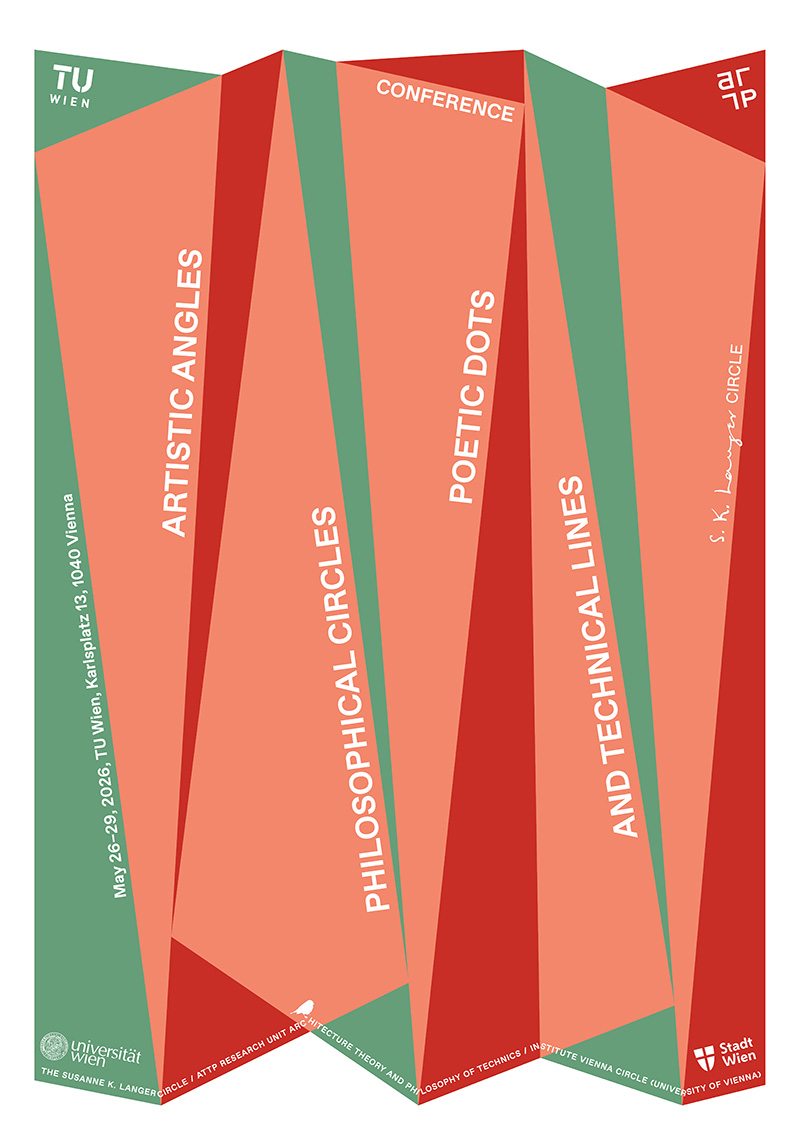
SUSANNE K. LANGER:
Artistic Angles, Philosophical Circles, Poetic Dots, and Technical Lines
The architectonic vernacular of angles, circles, dots, and lines composes the conceptual sketchpad that maps the theoretical edifice of Susanne K. Langer’s work in logic, the arts, a philosophy of mind, and philosophy of science. This conference explores Langer’s philosophical framework and invites scholars as well as artists to actuate her philosophical methods, spanning from logical analysis and synthesis to embodied cognition, symbolic projection and understanding.
KEYNOTE SPEAKERS
Salomé Voegelin (CH), Sander Verhaegh (NL), and Adam Nocek (USA).
Artistic Angles
Perceived as an artists’ philosopher, Susanne K. Langer’s thought has informed media-theoretical debates on the affective turn, conceptual undercurrents of carnal rhetorics and speculations in new materialism(s), providing a toolkit to capture the artefacts of expressiveness. This distinctive artistic angle for theory shapes Langer’s approach to the body-mind and to aesthetic cognition. Her philosophy, synthesizing Alfred N. Whitehead’s process metaphysics and Ernst Cassirer’s anthropology of symbolic forms, echoes later post-structuralist movements in its exploration of non-linguistic dimensions of meaning. These intersections situate Langer’s philosophy of artistic expressiveness as a mode of epistemological import.
Philosophical Circles
Langer’s orbital relationship with the Vienna Circle is exemplified in her 1930 book, The Practice of Philosophy (praised by Moritz Schlick), in which she was among the first to articulate the “’analytic` type” of philosophy (p. 17), well before its widespread adoption in the 1950s. She also played a key role in helping exiled Vienna Circle members (e.g. Herbert Feigl or Eugen T. Gadol) settle in the United States in the 1930s and 1940s. Establishing her own philosophical circle at Harvard, devoted to the discussion of logic, Langer bridged the transatlantic evolution of analytic philosophy. Her scholarly thinking blended empirical rigour and experiential meaning-making with process-oriented thought.
Poetic Dots and Technical Lines
Langer’s legacy – one that bridges philosophical and epistemic divides – invites a re-negotiation of living form; for Langer, mind is grounded in an intricate matrix of exogenic and autogenic processes that expand the idea of living and non-living entities, and the systems they are embedded in. The continued computational turn – advancements in algorithmic learning and synthetic biology – blur the contours of mechanics and organism, life and form.
This conference seeks to make tangible the poetic and technological transversality currently intersecting philosophy, science, and the arts.
Organized in collaboration with the Research Unit Architecture Theory and Philosophy of Technics ATTP at the Vienna University of Technology and the IVC Institute Vienna Circle at the University of Vienna, this conference illuminates the history and relevance of Susanne K. Langer’s philosophy—demonstrating how her thought continues in contemporary debates in philosophy, aesthetics, the arts, and science, and how it is linked to the city of ideas, Vienna.
Committee: Prof. Vera Bühlmann (AT), Dr. Lona Gaikis (AT), Tereza Hadravová (CZ), Dr. Matthew Ingram (USA), Prof. Randall E. Auxier (USA), Prof. Christian Grüny (DE).
PROGRAMME
TUESDAY, 26 MAY 2026 – ARTISTIC ANGLES
Kuppelsaal, TU Wien
09:30 Registration
10:00 Introduction
Prof. Vera Bühlmann, Prof. Georg Schiemer, Dr. Lona Gaikis.
11:00-17:30 Plenary Sessions
19:00 Salomé Voegelin (CH/UK) PUBLIC KEYNOTE
Sonic Possible Worlds and the Desire for Philosophical Collaborations Across an Unmeasurable Time
20:00 “On the Resources of Feeling” PANEL DISCUSSION
Dr. Megan Poole, Dr. Krista Ratcliffe, Dr. Kyle Jensen and Prof. Adam Nocek.
Milena Georgieva (BG/AT) SOUNDSCAPE
WEDNESDAY, 27 MAY 2026 – PHILOSOPHICAL CIRCLES
Boecklsaal, TU Wien
09:30-17:30 Plenary Sessions & Posters
19:00 Dr. Sander Verhaegh (NL) PUBLIC KEYNOTE
Between Two Circles: Langer and the Making of American Analytic Philosophy
20:00 “Susanne K. Langer and the Vienna Circle” PANEL DISCUSSION
Prof. Juliet Floyd, Dr. Silke Körber and Dr. Sander Verhaegh.
Moderated by Dr. Christoph Limbeck-Lilienau (IVC) and Dr. Lona Gaikis.
THURSDAY, 28 MAY 2026 – POETIC DOTS
Boecklsaal, TU Wien
09:30-18:00 Plenary Sessions
19:30 Prof. Adam Nocek (USA) PUBLIC KEYNOTE
From Computability to Semblance: Susanne K. Langer on Artificial Aesthetics in Biology
Jakob Schauer (AT) SOUNDSCAPE
FRIDAY, 29 MAY 2026 – TECHNICAL LINES
Kuppelsaal, TU Wien
09:30-17:00 Plenary Sessions
SALOMÉ VOEGELIN
Sonic Possible Worlds and the Desire for Philosophical Collaborations Across an Unmeasurable Time
This keynote takes the form of a curatorial performance, that is, it does not deliver a paper but performs ideas by playing sounds and reciting poetry, by reading texts and proposing text-scores, by moving and standing still, to bring art and its theorising into simultaneity, not to know systematically but to generate how we might know contingently from everything at once. This seems important to me particularly in relation to Susan K. Langer for whose philosophy I have a complex appreciation: admiring her identification of the problems of art theory in the 1940s, and her motivation to do things otherwise, while disagreeing with her sense that we can or should know art in a scientific way, particularly in the 1940s.
Inspired by this conflict, this keynote as curatorial performance engages the possibility of a co-generated philosophy and art. Recognising our desire for connections, which motivates a cross-time collaboration, and produces plural understandings of what we consider useful, relevant and real.
To do so, this curatorial performance turns to sound and engages the philosophy of sonic possible worlds: the imaginary of a plural world of invisible slices, all real simultaneously and legitimised in experience rather than through a singular and calculable world. It does so to discuss the aesthetics of a relational everything-at-once from which objectivity loses its distance and gains responsibility for what we hear not as outcome but as process, generating the work and the world in an unmeasurable time. And that is where I hope to re-meet Langer, in 2026, in the studio, without searching for scientific rigour but co-generating the possible impossibility of the work and the world: to see the actual and hear the possible expand its vision.
Link: www.salomevoegelin.net
SANDER VERHAEGH
Between Two Circles: Langer and the Making of American Analytic Philosophy
Historians of American philosophy often portray the analytic turn as a rupture. Richard Rorty wrote about a “take over” by European émigrés, who “showed up thanks to Hitler and various other historical contingencies”. Roy Wood Sellars described the analytic method as “a new kind of colonialism” led by Viennese scientists who knew little about American philosophy. This paper challenges this narrative, using the encounters between Langer and the Vienna Circle to argue that analytic philosophy should not be viewed as European export but as a product of transatlantic exchange. First, I draw on archival material to show that American philosophy already harboured a substantive community of proto-analytic philosophers, exemplified by Langer’s circle of philosopher-logicians, well before it developed contacts with the Vienna Circle. Next, I reconstruct how Langer and her contemporaries tried to bridge cultural differences by developing different proposals for how to characterise the new philosophy. Finally, I argue that neither Langer nor the logical empiricists were able to control the narrative, focusing on the social mechanisms that contributed to the rise of a conception of analytic philosophy that still dominates the field today.
Link: https://www.sanderverhaegh.nl/
ADAM NOCEK
From Computability to Semblance: Susanne K. Langer on Artificial Aesthetics in Biology
This talk attempts to situate technoscientific advancements in the biosciences in relation to Susanne K. Langer’s aesthetic biology. While precious little has been written about Langer’s art-infused biology, there seems to be even less to say about how Langer would respond to advances in computing technology – e.g., deep neural networks. This shouldn’t be surprising given that Langer does not offer a philosophy of technology, nor does she devote attention to theorizing technology as a symbolic form, as Ernst Cassirer did in Kunst und Technik. Despite this, the talk will show that Langer’s aesthetics are invaluable for reconfiguring the already fraught relation between artificial intelligence and biology. In doing so, the lecture offers a reconceptualization not only of artificial intelligence but also of Langer’s aesthetics, such that the latter can be brought to bear on computing and biology to resolve tensions within today’s technosciences.
Link: https://adamnocek.com/